

-

-
 Programs &
Services
-
Nursery
Life -
Our
Locations -
Parents
Corner -
About
Blossom -
Read
Our Blogs -
Careers &
Trainings -
Contact Us
-
Book a Tour
Blossom Nursery’s New Science-backed Sustainable Education Approach
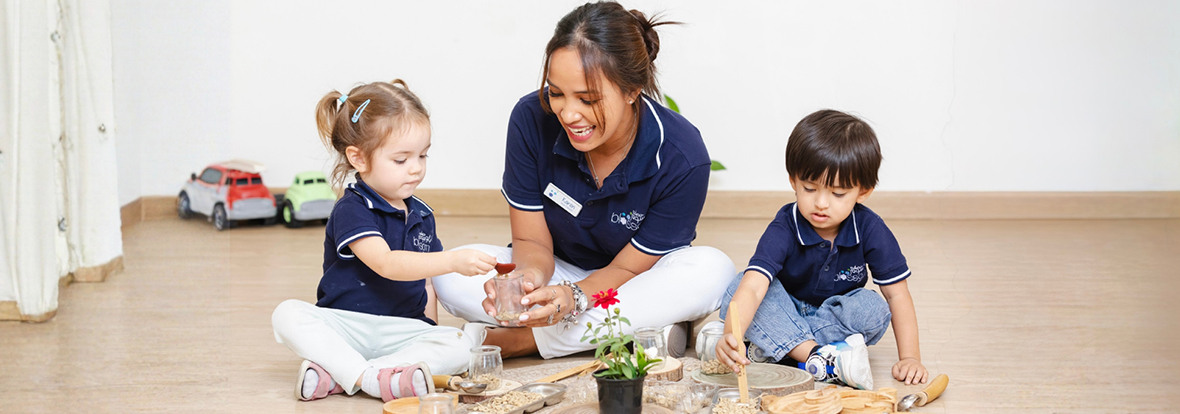
Across the world, there is growing recognition that the early years are a crucial stage in child development, laying the foundation for lifelong learning, wellbeing, and how children relate to others and navigate the world.
The Sustainable Education Approach®, developed by Babilou Family, reflects international commitments to strengthen early childhood education, including the Tashkent Declaration and Commitments to Action, which bring together governments worldwide around a shared vision to strengthen and improve early learning. Locally, the approach fully supports the UAE’s long-term vision, aligning with national strategies such as ‘We the UAE 2031’ and ‘UAE Centennial 2071’. This ensures that what happens in our classrooms contributes meaningfully to the country’s broader educational and developmental goals.
At Blossom, our educators deliver a world-class British EYFS curriculum. However, it is the educational approach that shapes how learning is experienced each day. What sets this approach apart is its ability to bring together the latest research in neuroscience, psychology and early childhood development with the enduring strengths of established early years practices, creating a clear, coherent framework for teaching and learning. In doing so, it sets a new benchmark for how early childhood education can be delivered with intention, integrity, and impact.
Our Sustainable Education Approach is built around six interconnected pillars that shape everything we do, from everyday routines to long-term development.
Here is a quick look at each pillar and how it is applied in practice:
Emotional and Physical Security
Young children are only ready to learn when they feel emotionally and physically secure.
A calm, intentionally set-up child-led environment and strong relationships with familiar educators help children feel safe and understood. When children experience this sense of security, they can focus on exploring, connecting and learning.
Natural Curiosity
Curiosity influences the development of higher executive functions.
Children learn best when they are free to follow their interests. We design spaces that encourage exploration, questioning and hands-on discovery, allowing curiosity to lead the way and support deeper thinking.
Nature-Based Learning
Studies have linked proximity to nature with better school performance.
Time in nature supports children’s wellbeing, attention and physical development. Nature is integrated into everyday learning through outdoor experiences, natural materials, and meaningful connections to the real world.
Child Rhythms
Respecting a child’s cues supports their optimal brain development.
Each child develops at their own pace. By tuning into individual cues such as sleep, hunger, interest and energy, our educators adapt routines and activities so learning feels natural and enjoyable.
Inclusion
Neuroscience shows that multicultural environments lead to greater emotional intelligence.
Blossom nurseries bring together families from many cultures and backgrounds. Children learn to appreciate differences, develop empathy and build strong social skills within a diverse and welcoming community.
Partnering with Parents
Science shows when educators partner with parents, child learning accelerates.
We see families as active partners. Open communication, shared routines and strong relationships between home and nursery create consistency and help children grow with confidence.
ZAINA SHIHABI
Zaina Shihabi knew that education was her passion early on in life. Prior to working in education, however, she worked in events, marketing, and later, editorial as the Mother, Baby and Child Magazine Editor. After completing a Master’s in Education, a PGCE and a PhD, she enjoyed teaching for several years before moving into management as Blossom Mudon Nursery’s Centre Director. Since September 2025, Zaina has been Blossom’s Head of Education.
In addition to her other degrees in mass communications and education, Zaina has also completed an NCFE CACHE Level 5 Diploma in Leadership for Health and Social Care and Children and Young People’s Services (England) and an NCFE Level 3 Certificate in Assessing Vocational Achievement.


ZAINA SHIHABI
December 19, 2025